

Culture Measurement: Moving From Type-Based to a Trait-Based Approach
By Paula Brockwell.
Most organisations are not short of culture data.
They have engagement scores, listening group themes, exit interview feedback, wellbeing results, values comments and action plans. Often, they have more than enough information to know that something is not quite working.
The difficulty comes next.
When leaders ask, “So what do we actually change?”, the answer is often less clear. The data may describe how people feel. It may show what people are frustrated by. It may even give the organisation a neat cultural label. But it does not always explain what is creating those patterns, or how to shift them.
This article disusses topics covered in Paula's ABP Speaker Session, "A Culture Nerds Guide to Measuring Culture" – watch the webinar here.
There are several critical limitations in current approaches to culture measurement. Culture is often confused with sentiment, and standard benchmarks are used when contextual, goal-specific standards would help businesses understand their culture more usefully. Those points are increasingly being discussed.
What I want to explore here is a different issue: why, despite the benefits seen in trait-based personality assessment, we have not yet made the same shift in culture measurement.
Limits of Type-Based Culture Measurement
Currently, the vast majority of culture diagnosis work is based on type-based models. Culture typologies can be useful, giving a language to something that can feel messy and difficult to hold.
But a label is not a diagnosis. If an organisation is told it is too hierarchical, too parental, too cautious or too consensus-led, that may resonate. But what does it tell leaders to do next?
The issue might sit in:
- Decision rights;
- Governance;
- Leadership habits;
- Performance signals;
- Planning rhythms;
- Manager confidence; or
- The psychological contract between the organisation and its people.
A broad culture type can point to a pattern. It does not always explain the conditions producing that pattern.
This is one reason culture work can become so frustrating. Leaders may accept the finding but still struggle to see the practical route forward.
Why a Trait-Based Approach Helps
A trait-based approach to culture measurement looks beneath the overall label and examines the drivers shaping how work gets done.
Rather than asking only, “What type of culture are we?”, it asks how the organisation operates across key cultural traits. For example:
- How decisions are made;
- How demand is managed;
- How performance is signalled;
- How authority flows;
- How collaboration works; and
- How expectations are reinforced.
If an organisation wants more ownership, a trait-based diagnostic approach allows us to explore questions such as:
- Whether people have clear authority
- Whether leaders keep pulling decisions upwards
- Whether mistakes are handled constructively
It also aligns with wider psychological thinking. Tett and Burnett’s trait activation model, for example, argues that traits are expressed as work behaviour when the situation provides relevant cues and opportunities. If we want to sustainably activate specific behaviour in organisations, we need to understand the cues, constraints and reinforcers in the system.
Building a Trait-Based Approach to Culture
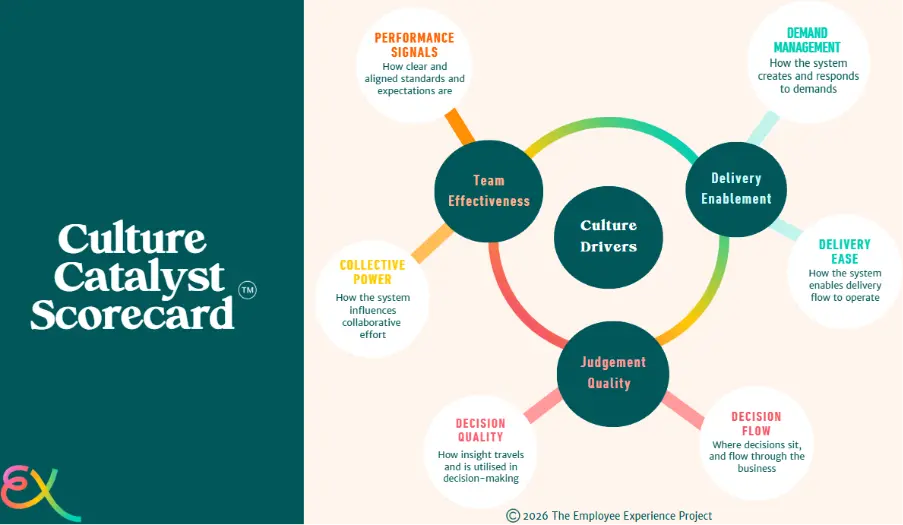
This is the thinking behind the Culture Catalyst Scorecard, which I discussed in our Culture Nerds Guide to Measuring Culture masterclass for The ABP.
The model was developed through a thematic analysis of over 50 previous multi-method, multi-source culture projects. From there, the team built an initial five-factor model, collected data through client work and an open-source diagnostic, and then carried out quantitative review, correlation analysis, factor analysis and literature review. The current model uses six cultural drivers, with psychological contract added as a supported factor through the literature review and practice evidence. In the analysis discussed in the webinar, the five-factor model predicted up to 56% of the variance in measured performance and behavioural outcomes.
Based on the factor analysis and literature review, we finalised our current model with six core traits, which are grouped into three broader areas to make the model easier to work with in practice:
- Teamwork
- Decision-making
- Demand management
Each trait is then supported by deeper contributory factors, allowing practitioners to move from a board-level conversation into more detailed diagnosis and action planning when needed.
What Next?
The biggest question we need to answer as psychologists is whether we are measuring culture at the level that helps organisations do something useful with the insight.
I’m calling for a move from broad type-based labels to trait-based diagnosis, to give leaders a clearer view of what is shaping behaviour and what needs to change. That is where culture measurement starts to become part of Business Psychology’s real contribution to workplace performance.
In the ABP webinar, I explore this in more depth, including personalised benchmarking, the evidence behind our Culture Catalyst Scorecard, and how to measure culture in a way that supports practical change.
For ABP Members:
Not a member? We invite you to join us at The Association for Business Psychology!
About the Author
Paula Brockwell is a Chartered Occupational Psychologist, founder of The Employee Experience Project, a culture change consultancy, and creator of Culture Nerd, an AI-enabled culture intelligence platform that helps organisations diagnose how culture is shaping performance, trust and adaptability. Learn more at www.TheExProject.com or www.Culturened.ai
References
Brockwell, P. (2025) Culture Nerd’s Guide to Measuring Culture. Webinar presented for the Association for Business Psychology, ABP Hub.
Cameron, K. S. and Quinn, R. E. (2011) Diagnosing and changing organizational culture: based on the competing values framework. 3rd edn. San Francisco: Jossey-Bass.
Johns, G. (2006) ‘The essential impact of context on organizational behavior’, Academy of Management Review, 31(2), pp. 386–408
Schneider, B., Ehrhart, M. G. and Macey, W. H. (2013) ‘Organizational climate and culture’, Annual Review of Psychology, 64, pp. 361–388.
Tett, R. P. and Burnett, D. D. (2003) ‘A personality trait-based interactionist model of job performance’, Journal of Applied Psychology, 88(3), pp. 500–517.
The Employee Experience Project (2025) Culture Catalyst Scorecard: evidence base and trait-based culture measurement approach.