

The Academic Practitioner Gap
By Adrian Furnham.
I am bilingual. I can speak two languages: “Academic Psycho-babble” and “Consultant Speak”. Neither language is superior, but both are very useful.
How did I become bilingual?
I am still a full-time academic and have been since 1979: U of Oxford (1979-1981); UCL (1981-2018), Norwegian Business School (2009-now). I publish books and papers; give lectures and supervise students.
I am also a consultant: I started doing consulting work from 1985 for two or three consultancies (Kiddy, Kaizen) and still work as an associate for a few. I also started my own company ABRA in 1986 and am still very active with a minimum turnover of > £100 K per annum. Finally, I also do executive coaching. I move between these different yet related worlds. I like to think I understand them.
This article discusses themes explored in Adrian Furnham's 2026 ABP Conference Keynote. Find the session slides here.
And for those in the assessment business, I am an African migrant with all the advantages and disadvantages of that. I am an extravert, ambitious, competitive, stable (ish), high self-monitor. I default on “yes” and am pleased to be called an “opportunist”. I am high on McClelland’s n.Ach and n.Affil. And I do quite well in intelligence tests.
I have among my close friends people from all these worlds… though fewest academics. They are very different, with mutual misunderstandings and mistrust. I chuckle when serious academics pour scorn on the “simple-minded analysis and conclusions of greedy, out-of-date consultants”. Equally I nod in agreement with my consultant friends who point out that “academics stuck in their ivory towers are impractical, naïve and utterly irrelevant”. I have coaching friends who have never considered the evidence for whether it ever works and have no qualifications whatsoever except the ability to bluff.
But, over time, I think I have become what cross-cultural psychologists call a mediating man. I like to think I can move happily between these various groups, taking from each the best of what they have to offer.
It is the migrant in me.
Major Differences
I do a good lecture on the difference between coaching, counselling, mentoring and psychotherapy. I also know the difference between an academic lecture and a business presentation. I know that teaching students about leadership and giving a lecture about leadership on a business course are not the same thing.
Years ago my good friend and co-author David Pendleton tried to make sense of these two worlds when comparing our experience of teaching work psychology and training managers. Both were demanding, but for different reasons.
- In academia, one had to keep seriously up-to-date with the growing complex literature; everything merited close scrutiny and criticism; and woe betide you if your analysis was “simple-minded”.
- As a consultant on a training course, I discovered that my task was to give advice and hone skills that lead to better outcomes. The idea was that I had studied various types of problems and had better solutions. At first, I felt a bit of a fraud: their expectations were too high. But I learnt that a few well-expressed myths plus a few counter-intuitive statements went down well.
Business people love case studies: these are a sort of parable, preferably with a happy ending. This is much rarer among the academics, who like to compare and contrast theories or evaluate the evidence in favour of a hypothesis. Humour works better in a consulting setting, though you have to be pretty careful these days. Consultants find out that their presentation style is all important: you have to be animated, enthusiastic, and persuasive. This is not true of academics, many of whom have “teaching difficulties” in the same way students have learning difficulties.
Students are expected to read the literature. Consulting clients expect you to read the literature for them and summarise it succinctly in everyday language.
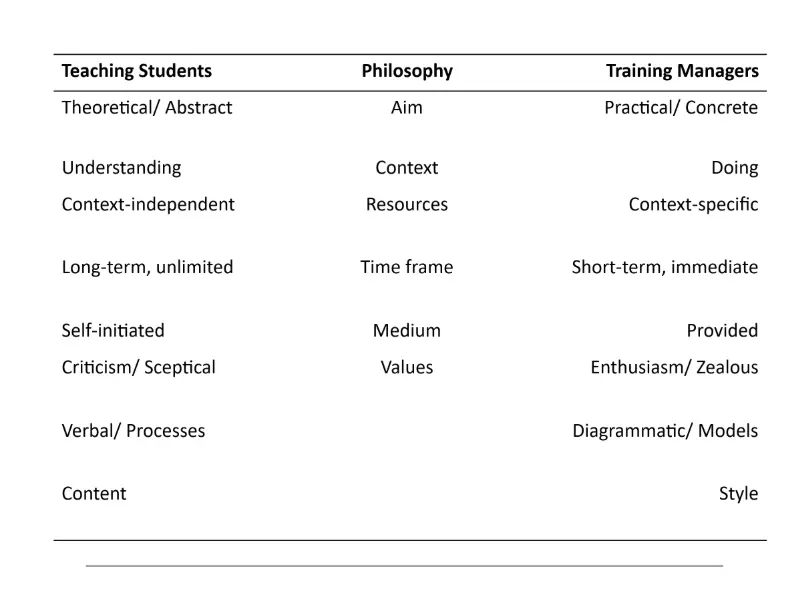
So what can we conclude? Though this may seem a crude exercise in stereotypes, I think there are often differences between academics and consultants.
First, the typical personality differences: In my experience, academics are much more likely to be Disagreeable Introverts, with a good dash of OCD Conscientiousness. Consultants tend to be Stable Extraverts (Sanguine), and many are high on Openness. Many academics score lamentably low on tests of emotional intelligence.
Second, skills: academics usually engage in serious analysis, be it logic or statistical. They pride themselves in “getting it right”, “interrogating the theory”, and drawing logical conclusions. Consultants have learnt to be good at marketing and sales; to establish and maintain good relationships; and to be up-to-date with all the fads.
Third, values. I am a fan of the Hogan MVPI. I come out high on three values.
- Affiliation: Valuing frequent and varied social contact, an interest in working with others, and a lifestyle organised around social interactions.
- Recognition: Valuing fame, being seen, visible, and noticed by others.
- Science: Valuing learning, an interest in new ideas, technology, and analytical problem-solving, and a lifestyle organised around exploring and understanding how things work.
Consultants score high on Commerce: Valuing business activities, money, and financial gain, an interest in realising profits and finding business opportunities, and Power: Valuing success, being influential, asserting authority and control and outperforming others.
Strengths and Weaknesses: in “positive psychology speak”, academics have a number. I have been taught by brilliant academics, but not all led me to run to the library or “go the extra mile”. I have been thrilled by their elegant analysis of complex issues and excited by my new understanding. Equally, I have come back from commercial conferences persuaded that intractable human problems can be overcome.
And equally I have been bored to death by academics quite indifferent to the (real) needs of students and the goal of learning. I have been driven mad by flaky consultants whose analysis of complex human problems is at best superficial and at worst wrong.
In Conclusion...
I think my temperament and lifestyle point towards consultancy, and my values and ambition to academia. I advise my students to do consultancy work for fun, money and real-world experience. I advise my consultant friends to keep up-to-date with the literature.
For ABP Members:
Not a member? We invite you to join us at The Association for Business Psychology!
About the Author
Adrian Furnham is the author of 99 books, and 1450 peer-reviewed papers. He has been a lecturer in Oxford (Pembroke College) and London (UCL). He set up a consultancy (ABRA) 40 years ago as a not-for-loss institution. He is Professor at the Norwegian Business School and has doctorates from Oxford, London and Natal University. He likes to think of himself as a well-adjusted workaholic.