

Reframing Sales: A Behavioural Capability for Business Psychologists
By Jim Bloomfield.
Many people feel uncomfortable with selling. For Business Psychologists, this discomfort can be particularly acute. A discipline grounded in ethics, evidence and human behaviour can feel misaligned with our traditional notions of sales as a ‘dark art’ often associated with exerting undue pressure on sceptical customers.
Yet to really have an impact upon the business world, Business Psychologists must sell. Every day we sell ourselves, our ideas and the value that our profession can bring to bear on complex organisational people and culture issues. It’s how we show up in these situations that impact our ability to influence at the highest levels. The question is not whether we need to sell, but how we can learn to sell effectively.
Applying a Behavioural Lens to Sales
Conventional approaches have tended to focus on articulating clear processes and rigid methodologies that remove the human element and reduce sales to a series of formal steps that, if executed correctly, will lead to a successful outcome. However, our research into high performance in complex, business-to-business environments show that this is the wrong approach. Drawing on a wide body of psychological and sales research, the Acuity for Strategic Sales framework (see attached whitepaper) offers a different perspective, by defining a set of core behavioural capabilities that underpin effective sales performance.
The model comprises three interconnected Dimensions:
- Personal Drive – an individual’s energy, belief, and resilience when engaged in sales activity
- Sales Focus – their capacity to turn expertise into insights that position themselves as a trusted advisor to clients
- Interpersonal Insight – their appreciation of the needs of different stakeholders and willingness to adapt behaviour to strengthen client engagement
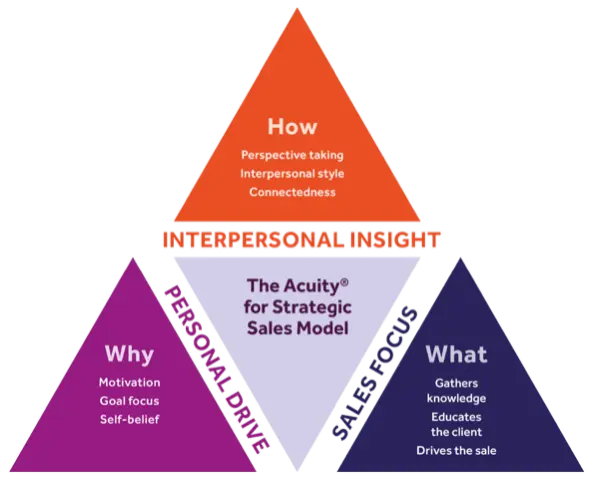
Together, these Dimensions reposition human behaviour as the fundamental driver of success in sales. Clearly, we as Business Psychologists have a lot to contribute to the conversation.
An Opportunity for Business Psychologists
Business Psychologists, like other professionals who have worked hard to build their technical knowledge and expertise over many years, find it difficult to accept their role as commercial influencers.
There are three common reasons for this that we see when working with clients. First, there can be a reluctance to engage in proactive “selling,” with a preference for organic demand or referral-based work. Second, there is often a belief that expertise alone will create impact without the need to actively shape client thinking. Third, even experienced practitioners may hesitate to challenge clients directly, particularly where this introduces tension into the relationship. As a result, many technically capable people become frustrated by their inability to influence key business decisions.
Acuity in Action
A recent sales transformation programme within a large technology organisation illustrates Acuity’s behavioural approach. The organisation faced a familiar challenge: its salesforce was technically strong but commercially limited. Sellers were described as “inch wide, mile deep” – able to engage in detailed product discussions, but less effective at identifying broader client needs or positioning themselves as strategic partners.
Critically for the business, there was no shared understanding of what effective sales behaviour looked like, nor a consistent way to assess or develop it. Using the Acuity framework, the organisation was able to introduce a behavioural blueprint across the sales teams. Individuals were evaluated using our Acuity psychometric tool, with managers trained to use the reports in their regular coaching conversations.
The results were significant. Sellers who demonstrated stronger alignment to the Acuity Capabilities substantially outperformed their peers in revenue terms. Just as importantly, the quality of their client conversations shifted – from transactional exchanges to more strategic, insight-led engagement.
How to Apply the Acuity Capabilities
For Business Psychologists, the Acuity Capabilities provide a practical framework for enhancing influence in our own client work.
1. Personal Drive: Reframing the Role of Sales
At its core, Personal Drive reflects intrinsic motivation, goal clarity, and resilience.
For psychologists, this begins with a reframing. Sales is not about persuasion; it is about helping clients make better decisions. This shift enables a more authentic engagement with commercial activity, grounded in purpose rather than discomfort.
Clarity of intent is equally important. Setting specific goals, not only for revenue, but for strategic conversations and opportunities, can sharpen focus and increase impact particularly if we break these down into specific actions and activities.
2. Sales Focus: From Problem-Solving to Problem-Finding
A defining feature of high-performing salespeople is their ability not just to solve problems, but to redefine them.
For Business Psychologists, this represents a significant opportunity. With our grounding in objective evidence, we are well placed to bring new perspectives to client challenges. However, this requires moving from being responsive to our clients to something more proactive.
Influential practitioners will seek out conversations where they can challenge assumptions and help clients to recognise the implications of their current approach, including the often-overlooked cost of inaction. In doing so, they shift from being service providers to trusted advisors.
3. Interpersonal Insight: Balancing Empathy and Challenge
The ability to understand and adapt to others is important to all aspects of work.
While empathy is often a well-developed capability among psychologists, the Acuity model highlights the importance of balance. Too much emphasis on harmony can limit effectiveness, particularly where a client’s thinking needs to be challenged.
Research suggests that the most effective influencers are those who combine perspective-taking with adaptability – adjusting their style, introducing constructive tension where needed, and engaging multiple stakeholders with differing priorities.
For Business Psychologists, this means moving beyond building rapport with our clients to a more deliberate and strategic use of our interpersonal skills.
From Expertise to Influence
The implications of this perspective are clear.
Sales, when understood behaviourally, is not at odds with Business Psychology. In fact, the two align perfectly. By engaging more deliberately with the behavioural dynamics of sales, through motivation, insight, and interpersonal effectiveness, Business Psychologists can enhance both their commercial impact and their contribution to organisational outcomes.
A Final Reflection
Sales will continue to feel uncomfortable for many of us (including myself). But like any other aspect of work, we can all learn, improve, and develop our capabilities. Reframed through a behavioural lens, sales becomes something more aligned with the values of Business Psychology: essentially a people-focused discipline where, by sharing our own knowledge and expertise in the right way, we add value and help our clients to think differently, decide more effectively, and make better decisions that ultimately drive business growth. In that sense, it is not a peripheral skill but a core professional capability.
For ABP Members:
Not a member? We invite you to join us at The Association for Business Psychology!
About the Author
Jim Bloomfield is Managing Director of Bloojam Consulting with over 20 years’ experience of applying Business Psychology to develop salespeople and leaders. He has successfully delivered projects globally across Europe, Middle East, North America and Australasia to support clients to achieve their growth ambitions.
Bloojam have developed the Acuity for Strategic Sales psychometric assessment, a measure of the key capabilities required for success in B2B sales, which is shortlisted for the ABP Awards 2026. He is a member of the Association of Business Psychology (ABP) and the British Psychological Society (BPS).
References
Open attached Acuity whitepaper in The ABP Community Hub ↓