
Why Generative AI Matters to Business Psychology
By Dexter Winters.
What does generative AI have to do with being a practitioner in the world of Business Psychology?
Everything.
Even in its current form, generative AI already carries the potential to disrupt large parts of how psychology is applied in business contexts. That disruption is only just beginning to wash through. As with many major technological shifts, there is a lag between hype and real impact. That lag can create a false sense of inertia; the impression that things are not yet changing in practice. But make no mistake: generative AI is already altering both what Business Psychologists do and how they do it.
This is an internet-level change. It is not something practitioners can opt in or out of. The only meaningful question is how we navigate it – and whether we do so in ways that protect professional standards, evidence, and human outcomes.
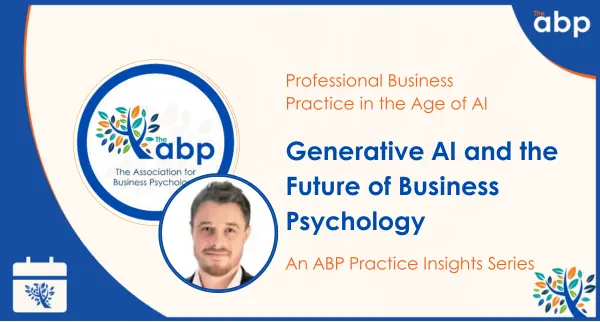
To explore this subject, I am hosting a six-part online event series on AI at Work throughout 2026. The first of these events is now open for registration. Until then, find my introduction to the conversation below.
AI at its Worst: A High-Face-Validity Imitation of Psychology
At its worst, generative AI offers a high-face-validity imitation of Business Psychology without the professional guardrails that give the work credibility:
-
It can produce assessments that appear rigorous and objective while resting on opaque models with unknown validity and untested bias.
-
It can generate confident organisational diagnoses and strategic recommendations that flatten complex systems into overly tidy narratives, stripped of context, power dynamics, and history.
-
It can deliver scalable coaching and development experiences that feel personalised but lack clear developmental models, psychological contracting, or accountability.
-
It can enable behavioural interventions that influence decisions and actions without sufficient transparency, consent, or evaluation.
-
It can offer immediate wellbeing support that sounds reassuring but lacks the judgement, escalation pathways, and duty of care required when stakes are high.
In each case, the risk is not that the output looks crude, but that it looks plausible, masking deep questions about evidence, ethics, and professional responsibility.
AI at its Best: A Complement that Amplifies Professional Judgement
At its best, generative AI acts as a genuine complement to Business Psychology, amplifying professional judgement rather than substituting for it.
-
It can support the rapid generation and refinement of assessment content under clear psychometric governance, enabling more thoughtful design and iteration.
-
It can help surface patterns, tensions, and hypotheses in complex organisational data that warrant deeper human sensemaking rather than premature conclusions.
-
It can extend learning and coaching by providing timely prompts, practice opportunities, and reflection, while remaining bounded by human oversight and clear developmental intent.
-
It can support more precise and transparent behavioural interventions when goals, ethics, and evaluation are explicitly designed in.
-
It can enhance wellbeing approaches by improving access to information and support, while psychologists retain responsibility for judgement, escalation, and care.
In these cases, AI increases the reach and effectiveness of our work precisely because its use is shaped, governed, and interpreted through professional expertise.
Holding Both Truths: Threat and Opportunity
Both narratives are true. AI is a threat and an opportunity. The difference lies in how it is engaged with.
This tension affects not only individual practitioners, but also our clients, employing organisations, and the wider credibility of the profession.
Crucially, this is not just a technological shift. It is a catalyst for systemic, behavioural, and societal change. Questions of trust, authority, responsibility, motivation, fairness, and evidence sit at its core –areas where psychology has always had something essential to contribute.
Why Business Psychology Practitioners Matter More, Not Less
Those applying psychology in business contexts have never been more needed. But relevance alone does not guarantee influence.
To shape how generative AI takes hold in organisations, practitioners must be credible in their understanding of the technology: its capabilities, its limitations, and its failure modes. In this context, AI literacy is far closer to critical thinking, communication, and ethical reasoning than to traditional IT skills. It is about knowing what questions to ask, which claims to challenge, and where professional responsibility sits when human judgement is mediated by technology.
If practitioners of Business Psychology do not step into this space with confidence and nuance, others will fill the vacuum – often without the same commitment to evidence, ethics, or human outcomes.
2026’s challenge is not whether AI belongs in the application of psychology at work. It already does. The challenge is whether we are prepared to engage with it in ways that strengthen, rather than erode, the foundations of good professional practice.
Register for session one of Dexter’s AI at Work event series: Foundations for Professional Business Practice in the Age of AI, here: https://community.theabp.org.uk/networks/events/201634