Skip to content
Toggle main navigation
Association For Business Psychology logo
  • Hub
  • Events
  • Perspectives on Business Psychology
    • Industry Insights
  • Biz Psych Cup
    • 2025-2026 Biz Psych Cup
    • 2024-2025 Biz Psych Cup
  • Professional Development
    • ABPConneXt
    • ABP Affiliate - The Psychometric Forum
    • ABP Affiliate - The HR Curator
    • Opportunities
  • Awards
    • How to Enter
    • Categories
    • FAQs
    • ABP Award Winners
  • Membership Pricing
  • Who are the ABP
    Log in
    JOIN NOW

    Perspectives on Business Psychology

    Filter by category
    All
    ABP
    ABP Book Club
    AI
    Assessment
    Careers in BP
    Certification
    Change
    Coaching
    Consulting Cycle
    Culture
    See all

    Highlighted news

    Search results (23)

    Beyond AI Skills: The Psychology That Turns Learning Into Successful Organisational Change

    Beyond AI Skills: The Psychology That Turns Learning Into Successful Organisational Change

    By Erica Farmer.We are realising that AI adoption will not succeed through tools and training alone. Human skills are the unlock, but only when the right psychology is in place: agency, curiosity, critical thinking and the safety to experiment and challenge, with it being OK to occasionally get things wrong.For ABP Members: This is an article overview of learnings shared in the ABP Event: AI Pract
    9 November 2026
    From Recruitment Consultant to Business Psychologist: Careers in Business Psychology

    From Recruitment Consultant to Business Psychologist: Careers in Business Psychology

    From The ABP Membership Team, with Angus Robinson.For our new series 'Careers in Business Psychology', The ABP Membership Team invites practitioners to share their career path – how they ended up where they are today – as a helpful resource for anyone who may be interested in exploring a career in Business Psychology. For this article, Angus Robinson answered The ABP Membership Team’s questions, e
    28 September 2026
    Culture Measurement: Moving From Type-Based to a Trait-Based Approach

    Culture Measurement: Moving From Type-Based to a Trait-Based Approach

    By Paula Brockwell. Most organisations are not short of culture data. They have engagement scores, listening group themes, exit interview feedback, wellbeing results, values comments and action plans. Often, they have more than enough information to know that something is not quite working. The difficulty comes next. When leaders ask, “So what do we actually change?”, the answer is often less clea
    23 September 2026
    Why Some of Construction’s Best Future Talent May Never Apply

    Why Some of Construction’s Best Future Talent May Never Apply

    By Sarah Brislen. Construction’s skills shortage is usually discussed in terms of labour supply, training provision, wages, and an ageing workforce. These are important pressures. CITB’s latest Construction Workforce Outlook estimates that the UK will need around 206,000 additional construction workers between 2026 and 2030. Yet recruitment numbers alone may not tell the whole story. From a Busine
    7 September 2026
    Designing for Trust, Agency and Natural Resilience

    Designing for Trust, Agency and Natural Resilience

    By Steve Carter. Five practical moves for creating more living organisations In my previous article, I suggested that trust cannot simply be summoned back into organisational life. It is not created by saying “trust us”, nor restored by communication alone. Trust is better understood as an emergent property of the psychological ecosystem of work: the living relationship between people, systems, ro
    18 August 2026
    Trust Cannot Be Summoned Back Into Life

    Trust Cannot Be Summoned Back Into Life

    By Steve Carter. Thinking more ecologically about trust, agency and resilience The ABP Industry Insights Report on trust, work and organisational systems arrives at an important moment. Many organisations are operating in a world where trust can no longer be assumed, inherited or declared into existence. It has become more conditional, more localised and more dependent on whether people’s everyday
    11 August 2026
    HR Curator: Twitter’s X Vision: Reshaping the Digital Landscape

    HR Curator: Twitter’s X Vision: Reshaping the Digital Landscape

    This article was originally published on HRCurator.com on October 13, 2023 and has been republished here with permission following its transfer to our affiliate network.By Grant Polachek, Head of Branding, SquadhelpTwitter’s transformation into X has sent shockwaves through the digital landscape and beyond, dramatically altering branding and user experience. While visible changes exist at first gl
    22 June 2026
    HR Curator: The Rise of Skills Taxonomies

    HR Curator: The Rise of Skills Taxonomies

    This article was originally published on HRCurator.com on January 21, 2022 and has been republished here with permission following its transfer to our affiliate network.By Simon Carvi, HR Expert Contributor at Huneety.com.The world of work is changing fast, even more so since the pandemic. Some jobs are being replaced by automation, while others are facilitated by technology platforms and becoming
    22 June 2026
    Industry Insights 2026 Report

    Industry Insights 2026 Report

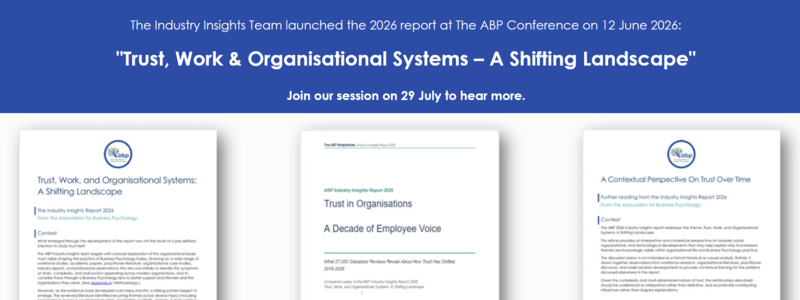
    At The ABP Conference 2026, The ABP Industry Insights Team launched their 2026 Report:"Trust, Work & Organisational Systems – A Shifting Landscape"Read the report, white paper, and article at the links below:Report: Trust, Work & Organisational Systems – A Shifting LandscapeWhite Paper: Trust in Organisations – A Decade of Employee VoiceArticle: A Contextual Perspective On Trust Over Time
    15 June 2026
    What Algorithmic Authority Is and Why it Matters for Business Psychologists

    What Algorithmic Authority Is and Why it Matters for Business Psychologists

    From The ABP Industry Insights Team. Algorithmic authority occurs when people trust what a system says because it is a system, rather than because they understand how it works, its limits, or the quality of its inputs. In organisations, this often sounds like: “The model says this is the best option.” “The system flagged them as high risk.” “The algorithm wouldn’t recommend that unless it was righ
    3 March 2026
    Mentorship, Innovation, and the Future of Work

    Mentorship, Innovation, and the Future of Work

    By Marianne Bremner.When Steve Jobs returned to Apple in 1997, he leaned on advice and mentorship from industry peers to reshape the company’s vision. What followed was one of the most remarkable corporate turnarounds in history, powered by creativity, risk-taking, and innovation. The lesson? Innovation rarely happens in isolation. It thrives in ecosystems where ideas are exchanged, challenged, an
    24 February 2026
    What Business Psychologists Need to Know When Working with LLMs

    What Business Psychologists Need to Know When Working with LLMs

    Large language models (LLMs), that is, AI systems that can generate human-like text, are beginning to appear in wellbeing apps, coaching tools and even therapy-adjacent services. They can help with admin, education and signposting. But evidence also shows real risks if they are used without clear guardrails.  This article distils several relevant takeaways for Business Psychologists, from a select
    3 February 2026
    Why Generative AI Matters to Business Psychology

    Why Generative AI Matters to Business Psychology

    By Dexter Winters.What does generative AI have to do with being a practitioner in the world of Business Psychology?  Everything. Even in its current form, generative AI already carries the potential to disrupt large parts of how psychology is applied in business contexts. That disruption is only just beginning to wash through. As with many major technological shifts, there is a lag between hype an
    26 January 2026
    The Next Generation of Business Psychology: A Profession in Excellent Hands

    The Next Generation of Business Psychology: A Profession in Excellent Hands

    If ever there were proof that the future of Business Psychology is bright, it can be found in the exceptional calibre of entrants to the Peter Saville Rising Star category of The ABP Awards. This category invites early-career Business Psychologists to share their success stories, for all to celebrate. This year’s many entrants showed technical excellence, intellectual curiosity, and an inspiring s
    20 January 2026
    Beyond the Headlines: Five Evidence-Based Priorities for Employers Supporting Gen Z at Work

    Beyond the Headlines: Five Evidence-Based Priorities for Employers Supporting Gen Z at Work

    By Clodagh O'Reilly.Stories about Gen Z rejecting “hustle culture” or employers struggling to recruit younger workers are now common across media feeds. These narratives often contain a kernel of truth, yet the conclusions drawn from them can be simplistic or even misleading. A single anecdote may capture attention, but it rarely captures the complexity of today’s workforce. For organisations, and
    14 January 2026
    Advocating for Business Psychology: How Every Practitioner Can Make a Difference

    Advocating for Business Psychology: How Every Practitioner Can Make a Difference

    The ABP Awards shine a light on the extraordinary breadth and depth of Business Psychology in action. And in our ‘best’ category entries, we also see clear evidence that advocacy – for each practitioner and the industry as a whole – is not just about visibility, it’s about impact. The best awards entrants have shown advancing the reputation and influence of Business Psychology is something anyone 
    12 January 2026
    The Psychology of New Year’s Resolutions – How to Succeed in Goal Setting!

    The Psychology of New Year’s Resolutions – How to Succeed in Goal Setting!

    By Dr Dawn H Nicholson.It’s the time when many of us are thinking about setting new goals and objectives for the coming year – have you done so in the form of a New Year’s Resolution? But effective goal setting is a critical skill. Failing to create or set a ‘good’ goal is like falling at the first hurdle.  In a longitudinal study of New Year’s resolvers, Norcross et al. (2002) found that those wi
    8 January 2026
    What the Evidence Tells Us About The Four-Day Working Week

    What the Evidence Tells Us About The Four-Day Working Week

    Why The ABP will be adopting a four-day working week model. The Association for Business Psychology (ABP) has taken an important step in aligning its internal practices with its mission: from December this year, our operational team members will work a four-day week. This decision supports positive working experiences for our staff, reinforces our commitment to evidence-based practice, and reflect
    4 December 2025
    The Future of Business Psychology: Custodians of Fairness and Human Sustainability

    The Future of Business Psychology: Custodians of Fairness and Human Sustainability

    As the Association for Business Psychology marks 25 years, we stand at a pivotal moment for our profession. Business Psychology has always evolved with the needs of organisations: from the spread of psychometrics in the 1980s, through the rise of boutique leadership consultancies in the 1990s, to the integration of fairness, ethics, and inclusion into global practice.  Today, Business Psychology i
    3 December 2025
    25 Years of The ABP: What We’ve Achieved and What Comes Next

    25 Years of The ABP: What We’ve Achieved and What Comes Next

    The ABP’s 25th Anniversary provided a powerful moment to pause and consider the Association’s contribution to Business Psychology since its inception in 2000. Members were invited to share their views on what The ABP has achieved in its first 25 years, and what the Association should focus on in the decades to come. Their reflections highlight a rich legacy of professionalisation, community buildi
    2 December 2025
    Contact
    The Association for Business Psychology
    81 King St, Manchester, M2 4AH, United Kingdom

    United Kingdom (Country)

    communityhub@theabp.org.uk
    +44 (0)161 883 7972
    Links
    • Terms of Use
    • Privacy Policy
    • Cookie Policy
    Cookies
    Withdraw cookie consent
    Community engagement platform by Hivebrite.