Skip to content
Toggle main navigation
Association For Business Psychology logo
  • Hub
  • Events
  • Perspectives on Business Psychology
    • Industry Insights
  • Biz Psych Cup
    • 2025-2026 Biz Psych Cup
    • 2024-2025 Biz Psych Cup
  • Professional Development
    • ABPConneXt
    • ABP Affiliate - The Psychometric Forum
    • ABP Affiliate - The HR Curator
    • Opportunities
  • Awards
    • How to Enter
    • Categories
    • FAQs
    • ABP Award Winners
  • Membership Pricing
  • Who are the ABP
    Log in
    JOIN NOW

    Perspectives on Business Psychology

    Filter by category
    All
    ABP
    ABP Book Club
    AI
    Assessment
    Careers in BP
    Certification
    Change
    Coaching
    Consulting Cycle
    Culture
    See all

    Highlighted news

    Search results (22)

    Building the Human-Centric Organisation: The Psychology of Thriving Teams and Cultures

    Building the Human-Centric Organisation: The Psychology of Thriving Teams and Cultures

    By Shameen Mehta. For decades, the corporate world defined a "good" organisation by its output, viewing employee wellbeing as a secondary byproduct of success. Today, Business Psychology has flipped this paradigm: organisations that are genuinely good for their people are the ones that achieve sustainable, long-term success.Creating a human-centric workplace requires moving beyond superficial perk
    18 November 2026
    More Than Words: Using Strengths-Based Approaches to Build Psychological Safety

    More Than Words: Using Strengths-Based Approaches to Build Psychological Safety

    By Michele Deeks. Recent evidence suggests that creating and maintaining workplaces where everyone feels psychologically safe is something we’re making limited progress on. The most recent data from Mental Health First Aid England suggests that only 55% of UK employees feel able to raise mistakes or risks at work. It’s easy to point to changes within the world of work over the last couple of decad
    17 November 2026
    Beyond AI Skills: The Psychology That Turns Learning Into Successful Organisational Change

    Beyond AI Skills: The Psychology That Turns Learning Into Successful Organisational Change

    By Erica Farmer.We are realising that AI adoption will not succeed through tools and training alone. Human skills are the unlock, but only when the right psychology is in place: agency, curiosity, critical thinking and the safety to experiment and challenge, with it being OK to occasionally get things wrong.For ABP Members: This is an article overview of learnings shared in the ABP Event: AI Pract
    9 November 2026
    A Safe Workplace Must Be Safe for Difficult Conversations

    A Safe Workplace Must Be Safe for Difficult Conversations

    By Miguelle James. Abstract:Psychological safety is often confused with the absence of discomfort. Drawing on Business Psychology research, this article examines how silence, power dynamics and the avoidance of difficult conversations undermine workplace trust and accountability. It argues that genuine workplace safety is not defined by the absence of challenge, but by how organisations enable and
    9 November 2026
    Calling Collapse™: What Organisations Can Do When Masking Meets a Deeper Sense of Purpose

    Calling Collapse™: What Organisations Can Do When Masking Meets a Deeper Sense of Purpose

    By Dr Jen Spencer. This is the second in a two-part series on neurodivergent professionals and the hidden cost of appearing fine at work. The first article in this series argued that psychological safety is not only something a team creates. For neurodivergent professionals, years of learning which traits are met with acceptance can produce a self-imposed unsafety that persists even in genuinely s
    26 October 2026
    How Masking Shapes the Calling of the Neurodivergent Workforce

    How Masking Shapes the Calling of the Neurodivergent Workforce

    By Dr Jen Spencer. This is the first in a two-part series on neurodivergent professionals and the hidden cost of appearing fine at work, every day, in workplaces that consider them dependable. Masking, sometimes called camouflaging, is the conscious or unconscious suppression of natural neurodivergent traits to meet neurotypical workplace norms. It is a learned strategy, not a fixed trait, shaped
    5 October 2026
    Culture Measurement: Moving From Type-Based to a Trait-Based Approach

    Culture Measurement: Moving From Type-Based to a Trait-Based Approach

    By Paula Brockwell. Most organisations are not short of culture data. They have engagement scores, listening group themes, exit interview feedback, wellbeing results, values comments and action plans. Often, they have more than enough information to know that something is not quite working. The difficulty comes next. When leaders ask, “So what do we actually change?”, the answer is often less clea
    23 September 2026
    The Academic Practitioner Gap

    The Academic Practitioner Gap

    By Adrian Furnham. I am bilingual. I can speak two languages: “Academic Psycho-babble” and “Consultant Speak”. Neither language is superior, but both are very useful. How did I become bilingual?I am still a full-time academic and have been since 1979: U of Oxford (1979-1981); UCL (1981-2018), Norwegian Business School (2009-now). I publish books and papers; give lectures and supervise students.I a
    21 September 2026
    Resilience Doesn’t Mean the Same Thing Everywhere: How Our Understanding of Resilience Depends on Culture and Why That Matters

    Resilience Doesn’t Mean the Same Thing Everywhere: How Our Understanding of Resilience Depends on Culture and Why That Matters

    By Scott Furlotte.Resilience is a popular buzzword in workplace wellness, leadership development, social media, and on the bookshelf in the self-help section. As practitioners and researchers, it is easy to make assumptions that we all think of resilience in the same way; as the ability to bounce back, thrive, and grow through adversity.  However, sometimes the concept of resilience takes on a nua
    14 September 2026
    Designing for Trust, Agency and Natural Resilience

    Designing for Trust, Agency and Natural Resilience

    By Steve Carter. Five practical moves for creating more living organisations In my previous article, I suggested that trust cannot simply be summoned back into organisational life. It is not created by saying “trust us”, nor restored by communication alone. Trust is better understood as an emergent property of the psychological ecosystem of work: the living relationship between people, systems, ro
    18 August 2026
    Trust Cannot Be Summoned Back Into Life

    Trust Cannot Be Summoned Back Into Life

    By Steve Carter. Thinking more ecologically about trust, agency and resilience The ABP Industry Insights Report on trust, work and organisational systems arrives at an important moment. Many organisations are operating in a world where trust can no longer be assumed, inherited or declared into existence. It has become more conditional, more localised and more dependent on whether people’s everyday
    11 August 2026
    Industry Insights 2026 Report

    Industry Insights 2026 Report

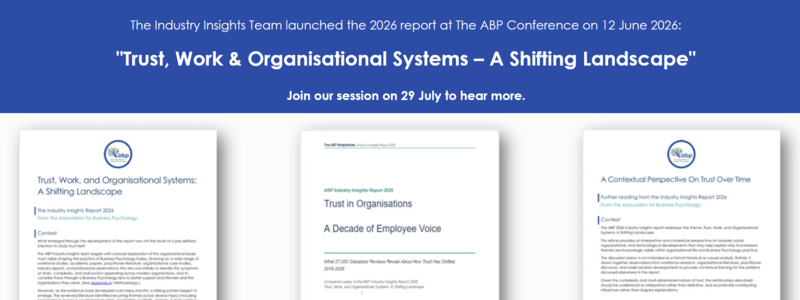
    At The ABP Conference 2026, The ABP Industry Insights Team launched their 2026 Report:"Trust, Work & Organisational Systems – A Shifting Landscape"Read the report, white paper, and article at the links below:Report: Trust, Work & Organisational Systems – A Shifting LandscapeWhite Paper: Trust in Organisations – A Decade of Employee VoiceArticle: A Contextual Perspective On Trust Over Time
    15 June 2026
    Projected Helplessness: How It Presents in Leaders, Teams, and Organisational Systems

    Projected Helplessness: How It Presents in Leaders, Teams, and Organisational Systems

    By Caralyn Bains AFBPsS. Projected Helplessness – when those who are perfectly capable suddenly present as though they are not – does not occur without a reason. Depending on our environments, it can emerge within families, friendships, or even workplace dynamics.  Understanding how the behaviour plays out in organisational systems gives leaders and practitioners the ability to interpret it accura
    11 March 2026
    Mentorship, Innovation, and the Future of Work

    Mentorship, Innovation, and the Future of Work

    By Marianne Bremner.When Steve Jobs returned to Apple in 1997, he leaned on advice and mentorship from industry peers to reshape the company’s vision. What followed was one of the most remarkable corporate turnarounds in history, powered by creativity, risk-taking, and innovation. The lesson? Innovation rarely happens in isolation. It thrives in ecosystems where ideas are exchanged, challenged, an
    24 February 2026
    Why Your Next Role Belongs on The ABP Job Board

    Why Your Next Role Belongs on The ABP Job Board

    The ever-growing complexities of the modern workplace mean that simply matching a CV to a job description may no longer let you find the right talent. Organisations that are navigating hybrid working, mental health challenges, and the need for sustainable productivity would need qualified people who understand the psychology and interactions underlying the work environment.  As such, if you’re rec
    16 February 2026
    Connection in Modern Job Seeking

    Connection in Modern Job Seeking

    The modern job hunt can feel exhausting, considering the saturation of most markets and the increased number of people reaching the job-seeking age. CVs are polished and cover letters are perfected, but often these attempts are met with silence. It’s an isolating experience that can chip away at anyone’s confidence, as they slowly lose the motivation to continue finding the right job. But, there i
    16 February 2026
    Invisible Seniority: When Influence Comes from Experience, Not Title

    Invisible Seniority: When Influence Comes from Experience, Not Title

    Invisible seniority refers to influence and authority that emerge from accumulated experience and contextual knowledge, rather than from formal titles or roles. It describes people who become trusted points of reference – those others turn to for guidance, sense-checking, or decision support – even though they are not managers, leaders by appointment, or formally senior in the organisational hiera
    11 February 2026
    Projected Helplessness: The Psychology Beneath the Behaviour

    Projected Helplessness: The Psychology Beneath the Behaviour

    By Caralyn Bains AFBPsS. Projected Helplessness, as expanded upon in the first article in this series, is the act of presenting oneself as unable to perform a task, despite preserved capacity, in order to elicit care, reassurance, closeness, or relief from responsibility. This behaviour is often easy to recognise but harder to understand. It may look simple on the surface, but the psychological ar
    9 February 2026
    Mentorship, Culture, and Retention: Why Organisations Can’t Afford to Ignore It

    Mentorship, Culture, and Retention: Why Organisations Can’t Afford to Ignore It

    By Marianne Bremner. In a world where job-hopping is the norm and employee loyalty can feel increasingly fragile, organisations are asking how they can retain their best people. The answer might not be higher salaries or trendy perks, but mentorship.When employees feel supported, connected, and invested in, they are far more likely to stay. A culture of mentorship signals to employees that their g
    26 January 2026
    Advocating for Business Psychology: How Every Practitioner Can Make a Difference

    Advocating for Business Psychology: How Every Practitioner Can Make a Difference

    The ABP Awards shine a light on the extraordinary breadth and depth of Business Psychology in action. And in our ‘best’ category entries, we also see clear evidence that advocacy – for each practitioner and the industry as a whole – is not just about visibility, it’s about impact. The best awards entrants have shown advancing the reputation and influence of Business Psychology is something anyone 
    12 January 2026
    Contact
    The Association for Business Psychology
    81 King St, Manchester, M2 4AH, United Kingdom

    United Kingdom (Country)

    communityhub@theabp.org.uk
    +44 (0)161 883 7972
    Links
    • Terms of Use
    • Privacy Policy
    • Cookie Policy
    Cookies
    Withdraw cookie consent
    Community engagement platform by Hivebrite.