

When High Performance Hides Strain: Recognizing Mental Health Pressure at Work
By Ursula Clidière and Anne Calleja.
A Short Vignette
Maya, a senior project lead, is still delivering every milestone after a demanding promotion. Her sponsor sees a capable professional who needs to delegate more. Yet Maya is sleeping poorly, preparing late into the night, checking messages repeatedly, and replaying conversations for hours. She interprets minor revisions as evidence that she is failing. From the outside, performance remains intact. Internally, sustaining it is increasingly costly.
High performance can conceal significant strain. For Business Psychologists, coaching practitioners, HR professionals, and leaders, the task is to notice changes in functioning, distress, context, and support without rushing to label them, then consider what workplace development can responsibly hold and where additional support may be needed.
Strain Does Not Always Look Like Crisis
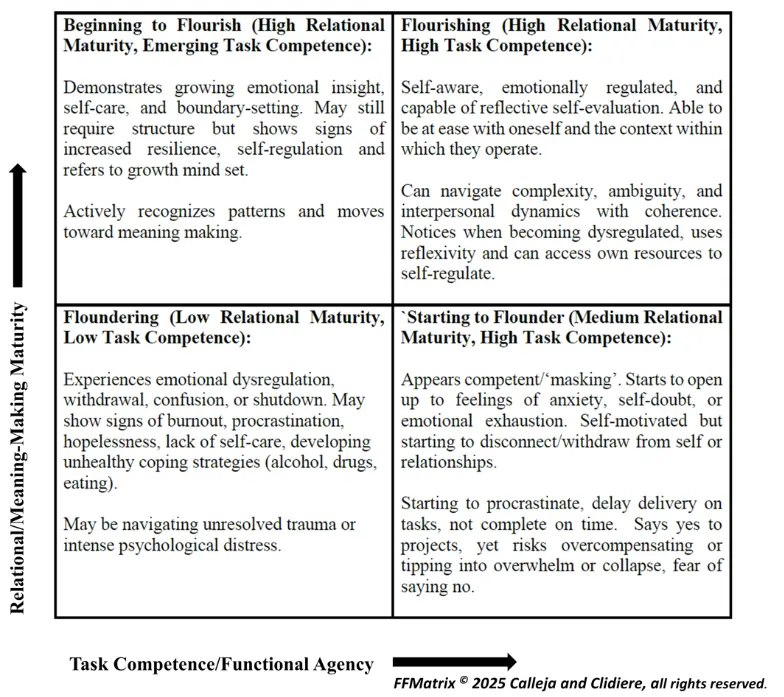
Mental health-related strain can remain remarkably quiet in high-performing environments. Our Flounder–Flourish Matrix (Calleja & Clidière, 2027) offers one way to make sense of this contradiction. A person may continue to function strongly in task terms while beginning to flounder emotionally or relationally. Maya’s disrupted sleep, repeated checking, overpreparation, and difficulty recovering suggest that the cost of maintaining performance is rising. This aligns with Keyes’ dual-continua model, in which mental health and mental illness are related yet distinct dimensions (Keyes, 2005).
These shifts invite curiosity rather than diagnosis. A more useful question is: What has changed, what is the impact on the person, and what support would be appropriate?
Discern Before Deciding
With Maya, a performance-focused response might conclude that she simply needs to delegate more effectively. A mental health-aware response stays curious for longer. Her workload has increased, her role is less clear, restructuring is creating uncertainty, and perfectionism appears to be intensifying. None of these factors alone explain what is happening. Together, and over time, they form a pattern.
Four areas can help hold that inquiry open:
- Functioning: What is Maya able to contain, and what is becoming more challenging?
- Distress: How intense, persistent, and disruptive is the experience? What is her ‘window of tolerance’?
- Context: What biological, psychological, relational, organizational, cultural, or systemic conditions may be shaping it?
- Support: What resources already surround the person, and what additional support may be needed?
The pattern matters more than any single sign. A difficult period may call for pacing and support; progressive deterioration, impaired functioning, or concerns about safety require a different response. Shifts in language, metaphor, and embodied response can also reveal what lies beneath an apparently straightforward performance issue (Calleja & Clidière, 2027).
Leaders face a similar challenge. Pischel et al. (2023) found that warning signals were more readily recognized when changes appeared across performance and socioemotional domains, while leaders’ own workload made recognition harder. The capacity to notice itself is shaped by context.
The Risk of Misreading Capability
Organizations can unintentionally reinforce costly patterns. Midnight responses are praised as commitment, taking on more as ambition, and never asking for help as resilience. High task competence can obscure a crucial question: what is sustaining this performance, and at what cost? The Health and Safety Executive (2025) identifies six work-design areas associated with stress when poorly managed: demands, control, support, relationships, role, and change. Several are visible in Maya’s situation.
Bachkirova (2026) adds a further dimension through identity regulation: organizations shape both what employees are expected to do and who they learn they are expected to be. Coaching can reinforce this when it supports adaptation to an ideal of the “successful employee” without examining whether that ideal contributes to strain. A psychologically informed response therefore asks what may need to change around Maya as well as within her.
What Coaching Can Responsibly Hold
Coaching can remain valuable when mental health themes enter work. Reflection, meaning-making, boundary setting, and values-based action may sit appropriately within coaching when the client retains sufficient capacity to engage with inquiry, make choices, and translate insight into action. Distress alone does not determine whether coaching should continue.
Consistent with the Global Code of Ethics (2025), the key question is whether the work remains within the practitioner’s capability and ethical scope. Scope may need to be reconsidered as the client, context, contract, and level of need change (Calleja & Clidière, 2027). McCormick and Forsyth (2026) similarly highlight client functioning, organizational influence, and triadic contracting as important distinctions in considering what coaching can responsibly hold.
For Maya, this may mean re-contracting beyond delegation to include workload, boundaries, role expectations, and agency. Supervision can help examine capability, emotional pull, sponsor expectations, and whether additional expertise is needed. Coaching may continue alongside other support, with referral approached collaboratively to preserve agency and continuity.
A Reflective Practice for Practitioners and Leaders
If the Flounder–Flourish Matrix helps us notice where someone may be moving, the Integrative Reflective Practice Model helps us examine how we make sense of what we notice and respond (Calleja & Clidière, 2027). It is structured around four movements:
- Attention: What am I noticing in the person, the wider context, and myself?
- Interpretation: What meaning am I making, and what alternative explanations remain possible?
- Enactment: How am I responding? What might I be avoiding, intensifying, or closing too quickly?
- Integrative reflection: What response now seems proportionate, and what may require re-contracting, supervision, additional support, or referral?
The same discipline applies to organizational leaders. Reflective practice widens the lens and asks: What are we part of, what are we reinforcing, and what might need to change?
Questions to Take Into Practice
- What consistent language patterns and behavioral nuances am I observing?
- What has affected the person’s ability to cope with ambiguity, functioning, behavior, or capacity to recover?
- What conditions may be contributing to or sustaining their response?
- Is the current coaching or development contract fit for purpose, and am I working within my scope and capability?
- Where is my focus of attention and what might I be missing?
- What needs to move into re-contracting, supervision, or discussion with an appropriately qualified professional?
Conclusion
The aim is to preserve agency, safety, and sustainable functioning while responding proportionately to emerging strain. High performance can coexist with significant difficulty, making it important to notice the cost of continued functioning and widen attention to the conditions around the person. Coaching may remain valuable, supported where needed by re-contracting, supervision, organizational action, parallel support, or referral. Ethical discernment keeps the response contextual, collaborative, and within appropriate scope.
For ABP Members:
Not a member? We invite you to join us at The Association for Business Psychology!
About the Authors
Ursula Clidière, PhD, is an organizational psychologist, AC Fellow, accredited Master Executive Coach and accredited Master Coach Supervisor. Her work integrates leadership development, adult development, mental health in coaching practice, and ethical discernment. Drawing on constructive-developmental and dialectical perspectives, she supports leaders, coaching practitioners, and supervisors working with complexity, reflective practice, and psychologically informed boundaries. Ursula teaches, supervises, researches, and contributes to professional education across coaching and adult development communities.
Anne Calleja, MSc, is a dually qualified psychotherapist and supervisor, executive coach, and master coach supervisor, with accreditations and registrations across BACP, UKCP, AC, APECS, and UCA. Her work bridges organizational systems, leadership development, psychotherapy, and coach supervision, translating psychological theory into ethical, relational, and practical support for leaders and practitioners. Anne is a former member and Chair Elect of the BACP Coaching Division executive and an honorary member of APECS.
Together, they co-authored Mental Health in Coaching Practice: Approaches to Navigate Intersecting Spaces (Routledge, 2027).
References
Bachkirova, T. (2026). Is organisational coaching a form of identity regulation or a form of resistance to it? Coaching: An International Journal of Theory, Research and Practice. Advance online publication. https://doi.org/10.1080/17521882.2026.2716627
Calleja, A., & Clidière, U. (2027). Mental health in coaching practice: Approaches to navigate intersecting spaces. Routledge. https://doi.org/10.4324/9781003570004
Global Code of Ethics. (2025). The global code of ethics for coaches, mentors and supervisors (Version 4). https://globalcodeofethics.org
Health and Safety Executive. (2025, January 13). What are the management standards? https://www.hse.gov.uk/stress/standards/overview.htm
Keyes, C. L. M. (2005). Mental illness and/or mental health? Investigating axioms of the complete state model of health. Journal of Consulting and Clinical Psychology, 73(3), 539–548. https://doi.org/10.1037/0022-006X.73.3.539
McCormick, I., & Forsyth, S. (2026). Coaching versus therapy: A quantitative, qualitative and conceptual analysis. International Journal of Evidence Based Coaching and Mentoring. Advance online publication. https://doi.org/10.1177/17418305261473093
Pischel, S., Felfe, J., & Krick, A. (2023). Health-oriented leadership: Antecedents of leaders’ awareness regarding warning signals of emerging depression and burnout. German Journal of Human Resource Management, 37(3), 169–198. https://doi.org/10.1177/23970022221130754