

Introducing a New Professional Framework for Workplace Wellbeing
By Sophie Walker.
Workplace wellbeing has grown rapidly over the last decade as organisations increasingly recognise the links between work design, mental health, organisational performance and workforce sustainability. For many organisations, this growing recognition has led to the creation of dedicated wellbeing roles and functions. However, the growth of workplace wellbeing as a professional field has outpaced a shared understanding of what effective practice actually looks like. While investment in wellbeing continues to increase, there has been little clarity about the knowledge, skills and capabilities required to deliver meaningful organisational impact
For Business Psychologists, this challenge will feel familiar. Much of what we describe as “wellbeing” in organisations sits squarely within the territory of applied behavioural science: shaping organisational behaviour, influencing leadership practice, improving work design and supporting healthier organisational systems. Yet despite this overlap, wellbeing roles have often developed without the professional clarity that exists in more established disciplines.
Why Do We Need to Define the Role of Wellbeing Professionals?
The absence of a shared professional framework creates challenges for both practitioners and organisations. In focus groups conducted by Affinity Health at Work in 2024, many practitioners described feeling deeply committed to improving working lives, but unsure about what “good practice” in wellbeing actually looks like, how to build credibility, and how to influence organisational decision-making.
Employers experience parallel challenges. Many want to invest in wellbeing but struggle to recruit the right capability, establish effective governance, or move beyond reactive initiatives.
One theme that emerged repeatedly was that wellbeing professionals often feel they need to justify the existence of their role. Wellbeing is frequently perceived as something that “anyone can do”. In reality, effective wellbeing practice requires significant expertise, drawing on multiple disciplines including occupational psychology, organisational development, health sciences, and risk management. Without a shared understanding of professional practice, it becomes difficult for practitioners to build credibility and for organisations to embed wellbeing effectively.
The Professional Framework for Workplace Wellbeing was designed to address this gap, providing the first evidence-based, multidisciplinary framework defining what competent wellbeing practice looks like across different professional backgrounds and levels of seniority.
What the Development of the Framework Involved
The need for greater clarity was strongly recognised by the Affinity Research Consortium – a network of employers, policymakers, and experts committed to strengthening the evidence base for work, health, and wellbeing. Each year, Consortium members vote on the research agenda. In 2025, the development of a professional framework for workplace wellbeing emerged as the top priority.
Working with a multidisciplinary Steering Group representing different professional backgrounds and levels of seniority, and in collaboration with institutions including IOSH, the Society of Occupational Medicine, and the CIPD, we undertook a rigorous seven-stage research process. This included academic and practitioner evidence reviews alongside extensive input from hundreds of wellbeing practitioners, employers, academics, and professional bodies across HR, Occupational Health, Health and Safety, and occupational psychology. Data was gathered through focus groups and a UK-wide survey, followed by multiple phases of analysis, framework development, mapping against existing professional standards and expert review.
Full details of the research process are available in a short research report launched on 18 March.
The Professional Framework for Workplace Wellbeing
The framework defines 45 areas of knowledge, skills and professional practice required for effective wellbeing work. Importantly, it recognises that wellbeing practice is inherently multidisciplinary. Professionals working in this space may come from backgrounds including HR, occupational psychology, occupational health, or health and safety. The framework therefore focuses not on professional titles, but on the capabilities required to deliver effective practice.
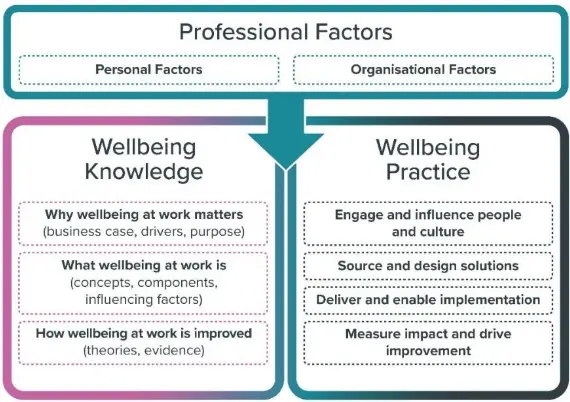
By articulating these capabilities, the framework provides a clearer foundation for professional practice in workplace wellbeing.
How the Framework Will Impact Workplace Wellbeing
For practitioners, the framework offers clarity about the knowledge, skills and capabilities that underpin effective practice. It can help professionals understand what “good” looks like, strengthen professional identity, and plan their development over time.
For organisations, it offers something that has often been missing: a credible benchmark for evidence-informed practice. Employers can use the framework to design roles, recruit appropriate expertise, build capability within teams, and strengthen governance around wellbeing activity.
Perhaps most importantly, the framework reframes wellbeing practice as a strategic organisational capability, grounded in prevention, psychosocial risk management, behaviour change, organisational culture, and robust evaluation – rather than a collection of disconnected initiatives or awareness campaigns.
This shift has the potential to significantly strengthen the impact of wellbeing across organisations.
What Does This Mean for Wellbeing at Work?
Ultimately, our hope is that this framework helps organisations move from doing wellbeing to being genuinely capable of delivering it well. That means embedding wellbeing within how work is designed, led, and experienced – supported by the right professional knowledge, skills and standards.
At Affinity Health at Work, our mission is to improve the working lives of all. By providing greater clarity for practitioners and organisations alike, we believe this framework can play an important role in strengthening professional practice and advancing wellbeing at work.
Note from the Author: Using the Framework
The framework has been freely available for use by practitioners and organisations from 18th March 2026.
To help professionals apply the framework in practice, Affinity has also developed a self-assessment profiling tool, launched on the same date. This will allow wellbeing practitioners to map their current knowledge and practice against the framework, identifying areas of strength and opportunities for development.
We are also working closely with professional bodies including the Society of Occupational Medicine and IOSH, as well as wellbeing qualification providers, to explore how the framework can support professional standards and training pathways.
Building on this work, Affinity is developing a suite of development opportunities aligned to the framework, including training modules, interactive workshops and practitioner learning groups. These will support professionals in building capability at different stages of their career and will begin launching in summer 2026.
Access the research report here: https://www.affinityhealthatwork.com/professional-framework-for-workp
About the Author
Sophie Walker is a Consultant at Affinity Health at Work, a multi-award-winning consultancy and research organisation, specialising in evidence-based wellbeing at work. Founded in 2006, Affinity’s mission is to improve the working lives of all. With a passion for using evidence-based approaches to identify and address workplace challenges and to support people and organisations to thrive together, Sophie works across various projects in the field of workplace health and wellbeing. Holding a BSc in Psychology and an MSc in Occupational Psychology, Sophie is excited to commence her Professional Doctorate in Occupational Psychology at Birkbeck, University of London in 2026.