

Beyond the Headlines: Five Evidence-Based Priorities for Employers Supporting Gen Z at Work
By Clodagh O'Reilly.
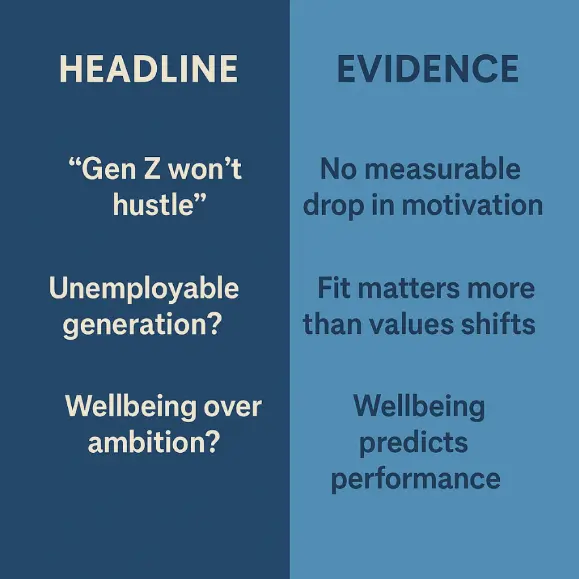
Stories about Gen Z rejecting “hustle culture” or employers struggling to recruit younger workers are now common across media feeds. These narratives often contain a kernel of truth, yet the conclusions drawn from them can be simplistic or even misleading. A single anecdote may capture attention, but it rarely captures the complexity of today’s workforce.
For organisations, and for Business Psychologists working alongside them, the real opportunity lies in moving beyond headlines to understand what research consistently shows about motivation, values, and performance.
Below are five evidence-based factors organisations should reflect on when designing environments where Gen Z and all generations can thrive.
1. True, Values Are Changing – But Values Alone Don’t Predict Performance
Many studies confirm that Gen Z, on average, place greater emphasis on wellbeing, authenticity, and social purpose than previous generations did at the same age. But research also shows that values do not reliably predict capability, work ethic, or job performance.
Meta-analytic evidence demonstrates minimal generational differences in core traits such as conscientiousness or career motivation once you control for career stage (Rudolph et al., 2021). Younger workers are not less capable; rather, they are navigating work differently.
What organisations can do:
-
Engage employees in values clarification and dialogue rather than making assumptions.
-
Use structured behavioural evidence, not generational stereotypes, when assessing talent.
2. Person-Organisation Fit Matters More Than “Changing Values”
One of the strongest findings in organisational psychology is the power of person–organisation fit (P–O Fit). Employees who experience alignment between their own values and those of the organisation report higher satisfaction, stronger commitment, better performance, and lower turnover (Kristof-Brown et al., 2005).
In practice, this alignment can take different forms. Supplementary fit reflects shared values, beliefs, and norms between individuals and the organisation, supporting trust, cohesion, and a sense of belonging. Complementary fit, by contrast, occurs when individuals bring strengths, perspectives, or capabilities that add to what the organisation already has, supporting learning, innovation, and adaptability. High-performing organisations tend to balance both: they are clear about core values and purpose, while welcoming diverse experiences and viewpoints that expand collective capability.
This insight shifts the narrative. Rather than asking individuals to suppress their values, an approach shown to increase burnout and reduce engagement, organisations can focus on clarity, transparency, and authenticity in the employer brand.
What organisations can do:
-
Be explicit about values, expectations, and working norms.
-
Recruit for alignment, not assimilation.
-
Allow space for diverse expressions of shared values.
3. Wellbeing is Not a Preference, It’s a Performance Resource
Studies consistently show that psychological wellbeing is a predictor of productivity, not a competing priority. The Job Demands–Resources (JD-R) model demonstrates that wellbeing, autonomy, and psychological safety are core predictors of motivation, engagement, and performance across generations (Bakker & Demerouti, 2017).
Younger employees’ emphasis on wellbeing should therefore not be understood as a rejection of work but as a recognition that wellbeing enables sustained performance. The desire for balance does not indicate low ambition; it aligns with decades of evidence on human motivation.
What organisations can do:
-
Build environments where energy, recovery, and clarity of expectations support high performance.
-
Treat wellbeing as a strategic resource, not a perk.
4. Career Development Needs Have Evolved, But the Fundamentals Endure
While headlines may focus on Gen Z’s “new” attitudes to work, the underlying needs – competence, progression, and learning – are universal. What has shifted is the context: flatter organisations, fewer entry-level training roles, and more precarious labour markets.
Research on career adaptability shows that young workers thrive when they can experiment, reflect, and build agency over time (Savickas, 2013). This aligns with Gen Z’s self-reported strong desire for accelerated learning, honest feedback, and meaningful progression (Deloitte, 2024).
What organisations can do:
-
Provide structured early-career development that builds confidence and capability.
-
Offer micro-skills opportunities, mentoring, and clear growth pathways.
-
Avoid relying on informal, sink-or-swim development approaches.
5. Anecdotes Attract Attention – But Evidence Builds Inclusion!
Workplace narratives about generations often rely on vivid stories: the TikTok post, the frustrated manager, or the one employee who didn’t want to work weekends. While memorable, these anecdotes are rarely instructive.
Research shows that stereotyping reduces collaboration, increases bias in hiring decisions, and undermines sense of belonging (Finkelstein et al., 2020). Inclusion is strengthened not by focusing on perceived divides, but by fostering environments where teams understand the structural, psychological, and economic factors shaping each person’s experience.
What organisations can do:
-
Replace generational labels with behavioural evidence and inclusive dialogue.
-
Use data and organisational psychology frameworks to interpret trends.
-
Encourage leaders to be curious, not categorical, about workforce differences.
It’s Time to Move Beyond Either/Or Thinking
The question is not whether wellbeing or ambition should matter more, or whether Gen Z needs to adjust to employers or employers to Gen Z. Instead, the evidence points to a more nuanced truth: workplaces thrive when people can align their values with the organisation’s purpose, experience psychological safety, and develop the skills that enable meaningful contribution.
This is not about rejecting the insights that anecdotes sometimes reveal; it is about complementing them with evidence that helps organisations design workplaces where every generation can succeed.
About the Author
Clodagh O’Reilly is a Certified Principal Business Psychologist with a track record of applying Business Psychology for performance turnaround, practical innovation, and talent development. Clodagh is an Honorary Member of The ABP who served as Chair of the ABP from 2013 to 2015, and again in 2023 and early 2024. She was the Founder of the ABP Workforce Experience Awards and has published several books sharing case studies from the programme.
References
-
Bakker, A. B., & Demerouti, E. (2017). Job Demands–Resources theory: Taking stock and looking forward. Journal of Occupational Health Psychology, 22(3), 273–285.
-
Deloitte (2024). 2024 Gen Z and Millennial Survey. Deloitte Insights.
-
Edwards, J., & Cable, D. (2009). The value of value congruence. Academy of Management Review, 34(1), 1–17.
-
Finkelstein, L. M., Voyles, E. C., & Thomas, C. L. (2020). Generational differences in workplace behaviour. Journal of Managerial Psychology, 35(3), 171–184.
-
Kristof-Brown, A., Zimmerman, R., & Johnson, E. (2005). Consequences of individuals’ fit at work: A meta-analysis of person–job, person–organisation, person–group, and person–supervisor fit. Personnel Psychology, 58(2), 281–342.
-
Rudolph, C. W., Rauvola, R., & Zacher, H. (2021). Generational myths: A critical review of evidence on generational differences in work-related variables. Work, Aging and Retirement, 7(1), 1–23.
-
Savickas, M. L. (2013). Career construction theory and practice. In S. D. Brown & R. W. Lent (Eds.), Career Development and Counselling (2nd ed.). John Wiley & Sons.
-
van den Bosch, R., & Taris, T. (2018). Authenticity at work: A literature review and research agenda. Journal of Occupational Health Psychology, 23(3), 338–351.