
CNOMT: A New Frontier in Emotional Regulation and Organisational Wellbeing
By Ioannis Kandianopoulos.
In today’s workplaces, the ability to stay emotionally balanced under pressure is as critical as technical skill. Yet, despite the wealth of wellbeing initiatives, stress, burnout, and emotional dysregulation continue to rise.
As an Organisational & Business Psychologist, my doctoral research led me to develop a new framework called Chromatic Neuro Ocular Motion Therapy (CNOMT), a method that combines colour, movement, and cognition to restore psychological balance and enhance performance. The CNOMT method aims to bridge the gap between neuroscience and organisational psychology, offering leaders and employees a practical pathway to self-regulation and emotional clarity.
The Science Behind CNOMT
CNOMT draws from three well-established scientific pillars (Figure 1):
-
Neuropsychology, which examines how brain function influences behaviour and emotion.
-
Ocular motion and attention research, which explores how guided eye movement can influence emotional processing.
-
Chromatic and affective science, which investigates how colour wavelengths modulate arousal, mood, and cognitive focus.
While the CNOMT method acknowledges the wider body of research connecting eye movement and emotional regulation (Lane et al., 2015; Shapiro, 2018), it represents a distinct and original approach in which the core of the method is designed as a neurocognitive and organisational intervention. Its purpose is not only to reprocess traumatic memories but to enhance emotional regulation, cognitive flexibility, and performance in professional and developmental contexts. The model integrates chromatic stimulation, ocular guidance, and reflective processing to support balanced executive functioning and stress recovery in the workplace (Spering & Carrasco, 2015).
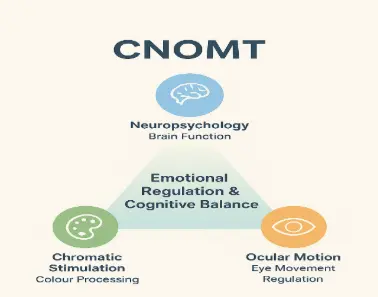
Figure 1: CNOMT integrates colour perception, ocular motion and neurocognitive feedback to regulate emotional arousal and executive function.
The CNOMT-ODS: Measuring Organisational Dysfunction
To bring the CNOMT method into the applied field of organisational psychology, a complementary diagnostic tool has been developed: the CNOMT-Organisational Dysfunction Scale (CNOMT-ODS).
The CNOMT-ODS serves as the analytical foundation of CNOMT, identifying and quantifying the patterns of dysfunction that undermine wellbeing and performance across workplace systems.
The scale evaluates six interrelated domains of organisational health (Figure 2):
-
Leadership Dysfunction: The emotional and behavioural impact of leadership style and self-awareness.
-
Communication and Culture: How openness, empathy, and psychological safety shape team dynamics.
-
Emotional Regulation and Wellbeing: The organisation’s collective ability to manage stress and emotional contagion.
-
Cognitive Load and Burnout: How overload and fatigue impair focus and judgment.
-
Decision-Making and Conflict: How bias and reactive emotion influence collaboration and problem-solving.
-
Systemic or Structural Barriers: Organisational rigidity, inequity, or procedural dysfunction.
Together, the CNOMT method and CNOMT-ODS tool create a dual framework; the tool diagnoses systemic emotional dysfunctions, while CNOMT method provides the intervention to restore balance. This integrated approach allows practitioners to design evidence-based interventions, track outcomes quantitatively, and evaluate progress using psychometrically informed tools.
This is especially relevant for organisations implementing ESG, CSR, DEIB, psychological risk-mitigation initiatives (such as those aligned with EU directives or ISO 45003), people analytics, organisational development practices, and workplace wellbeing or mental-health programmes.
The framework can also support ethical AI applications in talent acquisition, development, and retention by offering transparent, evidence-based metrics that integrate with existing digital HR systems. In other words, while CNOMT-ODS was developed as part of the CNOMT method, it functions effectively as an independent diagnostic instrument as well.
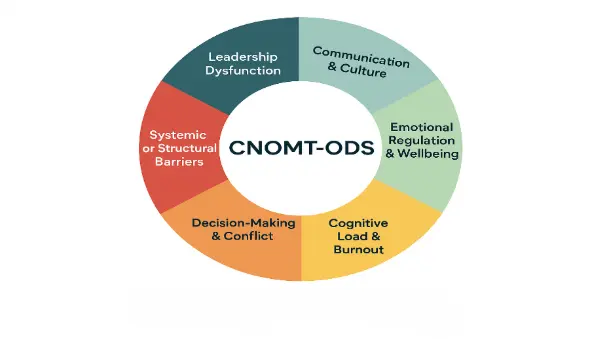 Figure 2: CNOMT-ODS (Organisational Dysfunction Scale), six domains of organisational dysfunction.
From Theory to Organisational Practice
In the workplace, emotional dysregulation often manifests as impulsive decision-making, communication breakdowns, panic episodes or disengagement. CNOMT offers a structured method to address these issues through guided visual exercises, reflective processing, and controlled breathing sequences (Koziol et al., 2013).
When applied with the CNOMT-ODS, organisations can identify dysfunction patterns and measure change over time. This data-driven approach supports leaders in developing emotional clarity, resilience, and decision accuracy while promoting cultures of empathy and self-regulation.
Why Colour and Movement Matter at Work
Colour and eye movement are more than aesthetic experiences, they are neurological stimuli. Cool hues such as blue and green lower physiological arousal, while warmer tones such as red and yellow increase activation and attention (Küller, et al., 2009; Küller, et al., 2009). Combined with controlled ocular tracking, these chromatic effects can stabilise emotional responses and restore cognitive balance under stress (Figure 3).
This aligns with the principles of embodied cognition, which view emotion as a multisensory process. By leveraging the visual system as a regulatory mechanism, CNOMT transforms emotional management from a purely cognitive task into a dynamic, physiological experience (Figure 4) .
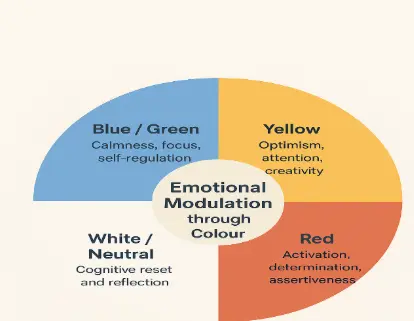
Figure 3: Emotional Modulation through colour.
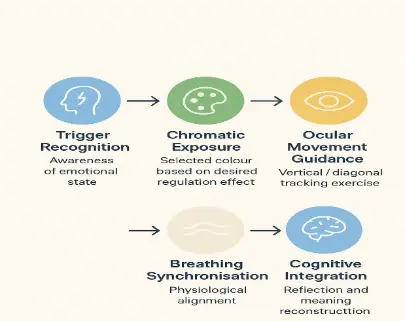
Figure 4: The CNOMT process engages sensory, physiological, and cognitive systems to restore emotional equilibrium and enhance executive fuction.
Implications for Business Psychology
For Business Psychologists, HR professionals, and leaders, CNOMT and CNOMT-ODS offer an integrative model linking neuroscience, behaviour, and organisational culture. The framework translates complex neuropsychological insights into practical tools for leadership development, burnout prevention, and systemic change.
Although CNOMT remains in validation, its conceptual design reflects The ABP’s vision for evidence-based innovation methods that not only analyse workplace behaviour but also actively cultivate resilience, empathy, and performance through scientific application.
Conclusion
As workplaces evolve under increasing cognitive and emotional pressure, we need tools that engage both mind and body (Toruń & Sak, 2018).
CNOMT and CNOMT-ODS together provide a blueprint for holistic emotional intelligence, diagnosing dysfunction, enabling regulation, and guiding transformation. The research is ongoing, but its early promise is clear: when individuals learn to see their emotions differently through colour, motion, and mindful awareness, they begin to lead and collaborate with greater balance and humanity.
The CNOMT framework builds upon existing evidence in neuroscience, colour psychology, eye movement desensitisation and reprocessing, and cognitive-behavioural research, with full academic references available upon request.
About the Author
Ioannis Kandianopoulos is an Organisational & Business Psychologist and Doctoral psychology researcher specialising in emotional regulation, wellbeing, and leadership. He is the creator of Chromatic Neuro Ocular Motion Therapy (CNOMT) and the CNOMT-ODS (Organisational Dysfunction Scale) innovative frameworks integrating neuroscience, colour psychology, and ocular motion to enhance workplace performance and mental balance. His research, under the supervision of Dr. Kopsidas Odysseas at the Aegean College in partnership with the University of Essex, which is currently in ethical review and validation, bridges academic rigour with practical application, advancing evidence-based emotional regulation in organisational contexts.
Note: CNOMT is currently in the phase of ethical review and data collection as part of its doctoral research framework. The method and its associated tools are undergoing validation and statistical analysis to establish psychometric reliability and empirical support. All findings referenced here are preliminary and form part of an ongoing research process.
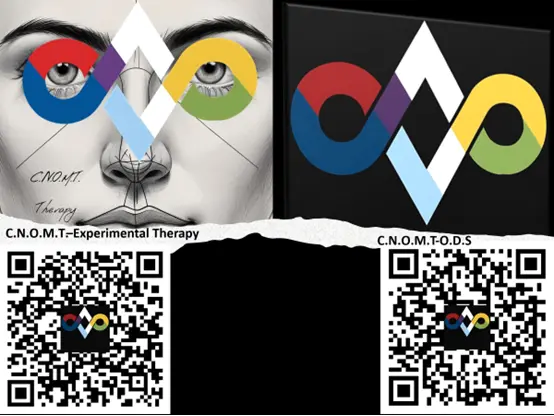
If you wish to be part of this research, please follow the above QR codes.
For those interested in a more detailed overview of the theoretical foundation, enjoy this presentation: https://www.youtube.com/watch?v=0otFqGrLvOI
References
-
Koziol, L. F., Budding, D. E., Andreasen, N. C., D’Arrigo, S., Bulgheroni, S., Imamizu, H., … & Yamazaki, T. (2013). Consensus paper: the cerebellum's role in movement and cognition. The Cerebellum, 13(1), 151-177. https://doi.org/10.1007/s12311-013-0511-x
-
Küller, R., Ballal, S., Laike, T., Mikellides, B., & Tonello, G. (2009). The impact of light and colour on psychological mood: A cross-cultural study of indoor work environments. Ergonomics, 49(14), 1496–1507. https://doi.org/10.1080/00140130600858142
-
Küller, R., Mikellides, B., & Janssens, J. (2009). Color, arousal, and performance. A comparison of three experiments. Color Research & Application, 34(2), 141–152. https://doi.org/10.1002/col.20476
-
Lane, R. D., Ryan, L., Nadel, L., & Greenberg, L. (2015). Memory reconsolidation, emotional arousal, and the process of change in psychotherapy: New insights from brain science. Behavioral and Brain Sciences, 38, e1. https://doi.org/10.1017/S0140525X14000041
-
Shapiro, F. (2018). Eye movement desensitization and reprocessing (EMDR) therapy: Basic principles, protocols, and procedures (3rd ed.). Guilford Press. https://psycnet.apa.org/record/2017-40757-000
-
Spering, M., & Carrasco, M. (2015). Acting without seeing: Eye movements reveal visual processing without awareness. Trends in Neurosciences, 38(4), 247–258. https://doi.org/10.1016/j.tins.2015.02.002
-
Toruń, N. C. U. I., & Sak, W. (2018). Daniel J. Siegel, The Developing Mind: How Relationships and the Brain Interact to Shape Who We Are, Guilford Press, New York–London 2012, pp. 506. Kultura I Edukacja, 120(2), 217–222. https://doi.org/10.15804/kie.2018.02.14